
Running a small business often means taking orders wherever customers happen to contact you.
One customer sends a WhatsApp message. Another phones. Someone else asks for prices on Facebook. A third customer wants to know whether you deliver.
Before long, you may find yourself answering the same questions repeatedly:
“How much is this?”
“Do you have it in stock?”
“How do I order?”
“Where must I pay?”
“Can I collect?”
“Do you deliver to my area?”
For some businesses, WhatsApp and phone orders work perfectly well.
But as the number of products, enquiries or customers grows, a simple online ordering website can make the buying process much clearer.
The important question is not whether every business needs complicated e-commerce.
Would giving customers a structured way to view your products and place an order make doing business with you easier?
Let’s look at what an online ordering website actually does and when it may make sense for a small business.
What Is an Online Ordering Website?
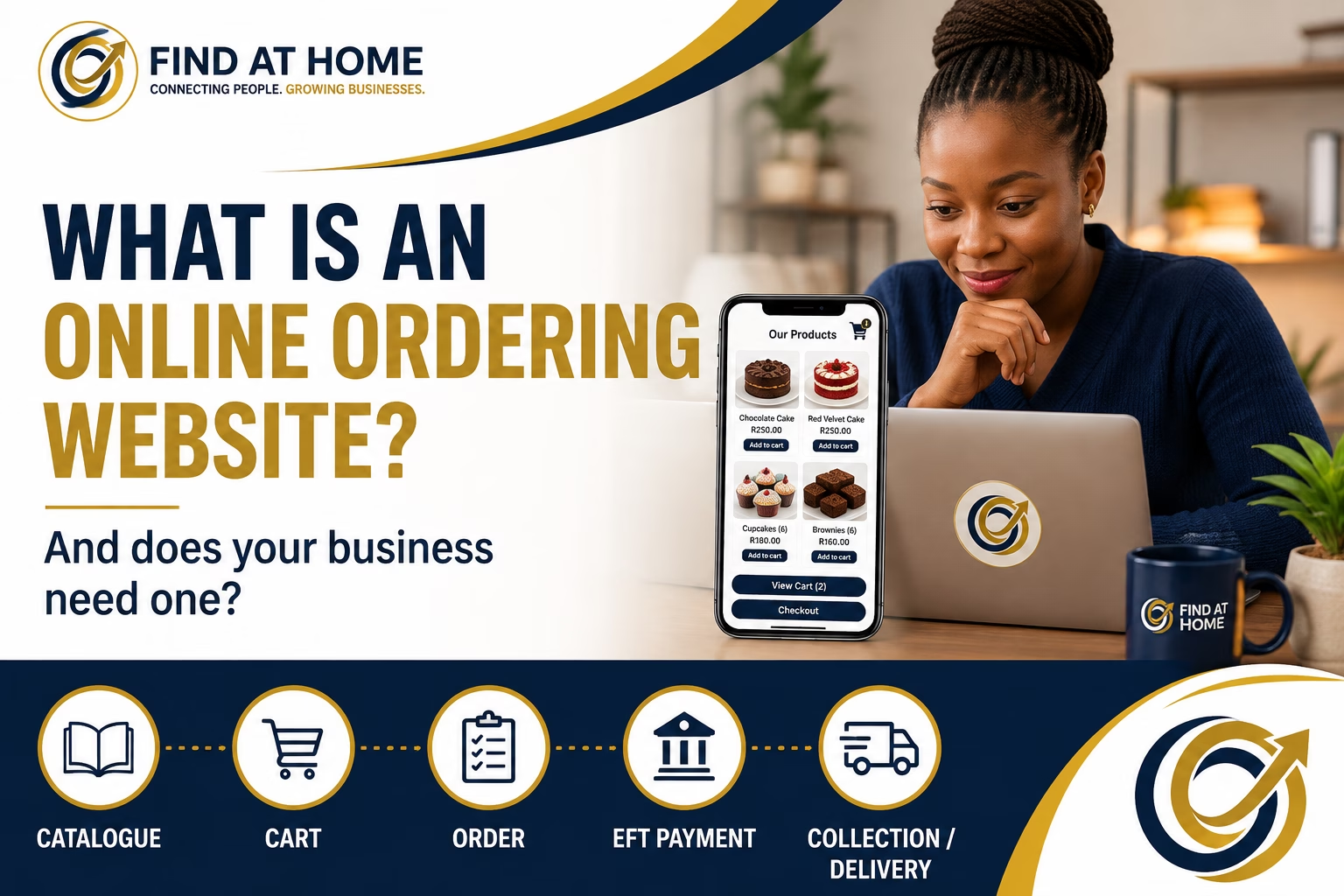
An online ordering website allows customers to view products, select what they want and submit an order through your website.
A simple process might look like this:
Product Catalogue → Cart → Checkout → Direct EFT / Bank Transfer → Order Confirmation → Collection or Basic Local Delivery
The customer can browse your products without first asking you to send photographs, prices and product information individually.
Instead of receiving a WhatsApp message asking you to send everything you sell, your customer can open your website and see:
- product photographs;
- product names;
- descriptions;
- prices;
- available options;
- collection information;
- basic local delivery information; and
- instructions for placing an order.
They choose what they want, add it to their cart and submit the order.
The website helps organise the ordering process. The business still controls the customer relationship and fulfilment.
Online Ordering Does Not Have to Mean Complicated E-commerce
When people hear the words “online store”, they sometimes imagine a large e-commerce operation with credit-card processing, warehouses, automated couriers, live stock systems and thousands of products.
That is one type of e-commerce.
But many SMMEs do not need that level of complexity.
A bakery selling 15 products, for example, may simply need customers to:
- see the available products;
- choose what they want;
- add the items to a cart;
- provide their contact details;
- receive payment instructions;
- pay the bakery directly; and
- collect the order or use an available local delivery option.
That is very different from building a large national e-commerce operation.
For many small businesses, simple, clear and reliable can be more useful than complicated.
How Does a Simple Online Ordering Website Work?
Imagine that you sell homemade food, baked goods, beauty products, clothing, gifts or household products.
A customer discovers your business online.
Instead of immediately having to WhatsApp you to ask what you sell, the customer opens your product catalogue.
Step 1 — Browse the products
The customer can see your available products, prices and descriptions.
Step 2 — Add products to the cart
They select the products they want. The cart keeps the order organised and shows what they have chosen.
Step 3 — Complete checkout
The customer provides the information needed for the order, such as their name and contact details.
Depending on the business, they may also choose collection or an available local delivery option.
Step 4 — Pay the business
A simple ordering website does not necessarily require an online payment gateway.
For example, the business may use Direct EFT or bank transfer.
The customer receives the appropriate payment instructions and pays the business directly.
Step 5 — Receive an order confirmation
The system creates an order record and can send the appropriate order notification.
Step 6 — Fulfil the order
The business confirms payment and prepares the order for collection or delivery according to its own process.
The website helps organise the transaction, but the business remains responsible for fulfilling the order.
Online Ordering Website vs WhatsApp Orders
WhatsApp is extremely useful for small businesses.
There is no reason an online ordering website and WhatsApp cannot work together.
But they solve different problems.
With WhatsApp, a typical conversation may look like this:
Customer: How much is this?
Business: R250.Customer: What colours do you have?
Business: Black, white and blue.Customer: Do you deliver?
Business: Yes, locally.Customer: How much?
Business: R80.
There is nothing wrong with that conversation.
But multiply it by 20 customers and you can see how much time disappears into answering repetitive questions.
A well-structured website can answer many of those questions before the customer contacts you.
WhatsApp can then be used for the questions that genuinely need personal attention.
The website does not have to replace WhatsApp. It can make WhatsApp more useful.
What Types of Businesses Can Benefit?
Online ordering is not only for large retailers.
A simple ordering website can potentially work well for businesses such as:
- bakeries and home bakers;
- caterers;
- florists;
- gift businesses;
- clothing sellers;
- beauty and hair-product suppliers;
- homeware businesses;
- small manufacturers;
- food businesses;
- party and event suppliers;
- personalised-product businesses;
- local retailers; and
- businesses with a manageable catalogue of repeat-order products.
The common factor is simple:
Customers regularly need to see what you sell before deciding what to order.
Signs Your Business May Benefit From Online Ordering
You do not need an online ordering website simply because other businesses have one.
Look at the way your own customers already behave.
You repeatedly send customers the same product information.
If you are constantly sending the same photographs, prices and descriptions through WhatsApp, a product catalogue can centralise that information.
Customers frequently ask how to order.
A customer should not have to work out your buying process. The clearer the next step is, the easier it is to do business with you.
You have a defined range of products.
If you have a manageable catalogue with clear products and prices, online ordering may be particularly suitable.
Orders are becoming difficult to organise.
When orders arrive through WhatsApp, Facebook, Instagram, phone calls and handwritten notes, mistakes become easier to make.
A structured ordering process can help keep important information together.
You want customers to browse outside business hours.
Your website does not have to close when you go home.
A customer who discovers your business late at night can still browse your products and potentially submit an order. You can handle it through your normal business process afterwards.
When Might You Not Need Online Ordering?
Not every business should build an ordering system.
If you provide highly customised services where every job requires an inspection, consultation or individual quotation, a normal business website with a strong enquiry system may be more suitable.
Examples could include:
- builders;
- plumbers;
- attorneys;
- accountants;
- consultants;
- architects;
- specialised repair businesses; and
- businesses where pricing depends heavily on individual requirements.
A plumber usually does not need customers adding “burst pipe repair” to a shopping cart.
The customer needs to contact the plumber.
In that situation, the website has a different job:
Build trust → Explain services → Make contact easy → Generate an enquiry
Choosing the correct type of website is more important than simply choosing the website with the most features.
Do You Need Online Card Payments?
Not necessarily.
A simple online ordering website can use Direct EFT or bank transfer.
The customer submits the order and pays the business directly.
This can work well for businesses that are comfortable confirming payment before preparing or releasing an order.
A third-party payment gateway can provide additional convenience and automation, but it also introduces another service provider, account approval, transaction fees, technical integration and its own terms.
Whether that makes sense depends on the business.
The important question is whether your customer can understand what to do next and complete the order reliably.
What About Collection and Delivery?
Start with what your business actually needs.
Some businesses may only offer collection from their premises.
Others might offer collection plus local delivery for a fixed fee.
Another business might offer free local delivery on orders over a certain amount.
These are relatively simple rules that can work well for a local business.
Advanced courier systems are different.
Live courier quotations, automatic waybills, national shipping calculations, courier APIs and automated courier bookings involve additional systems and integrations.
A small business does not necessarily need all of those features on day one simply because its website accepts orders.
Start With the Products Customers Actually Buy
Another common mistake is trying to put absolutely everything online immediately.
Suppose your business has 80 products but 15 of them generate most of your regular sales.
Starting with those core products may be more practical than delaying the entire website while trying to perfect a catalogue containing every possible item.
A smaller initial catalogue can also be easier to:
- photograph properly;
- describe clearly;
- price accurately;
- keep updated;
- manage stock for; and
- fulfil reliably.
You can expand your catalogue as the business and ordering process mature.
Your Website Does Not Run the Business for You
An ordering website can help customers submit organised orders.
It does not remove the business owner’s responsibility to operate the business.
You still need to:
- keep prices accurate;
- maintain product information;
- check availability and stock;
- verify customer payments;
- communicate with customers;
- prepare orders;
- manage collection;
- arrange actual delivery where offered;
- handle complaints;
- manage refunds or returns where applicable; and
- comply with the laws relevant to your products and business.
Technology should make the process easier.
It should not create the impression that the business no longer needs managing.
Does Your Business Need an Online Ordering Website?
Ask yourself:
- Do customers regularly ask to see my products?
- Do I repeatedly send the same prices and product information?
- Could customers reasonably choose what they want without speaking to me first?
- Would a cart make multi-product orders easier to organise?
- Do I have clear collection or delivery arrangements?
- Would accepting orders through my website save me time?
- Could customers place orders outside my normal business hours?
If you answered yes to several of these questions, an online ordering website may be worth considering.
If customers need a consultation or customised quotation before you can price the work, a normal business website with a strong enquiry process may make more sense.
Neither option is automatically better.
The right website is the one that matches how your customers actually buy from you.
Keep the First Version Simple
Small businesses sometimes delay getting online because they imagine they need a perfect, highly automated e-commerce system from the beginning.
You don’t.
Start with the customer journey.
Can customers find you → understand what you sell → see the price → choose what they want → place the order → understand how to pay → know what happens next?
If the answer is yes, your website is already doing something valuable.
More advanced functionality can be considered when the business genuinely needs it.
How Find At Home Approaches Online Ordering
Find At Home’s standard Online Ordering Website service is designed around a controlled, straightforward ordering process for SMMEs.
The standard flow is:
Product Catalogue → Cart → Checkout → Direct EFT / Bank Transfer → Order Confirmation → Collection / Basic Local Delivery
Standard Online Ordering packages can include up to 20 initial products, depending on the selected service.
Customers pay the business directly.
Find At Home does not receive, hold or process customer order money and does not take a commission on customer orders.
Collection and basic local delivery can be configured where appropriate.
More advanced requirements such as payment-gateway integrations, live courier rates, automatic waybills, courier APIs, large catalogues or complex e-commerce functionality need to be assessed separately.
The goal is not to give a small business every feature imaginable.
It is to give the business the right tools to make ordering easier for its customers.
Ready to Make Ordering Easier?
If your customers already ask for products, prices and ordering information through WhatsApp, Facebook or phone calls, it may be time to give them a clearer way to order.
Explore Find At Home Business Solutions to see the available website and Online Ordering options.
You can also view our Website Pricing or start an enquiry and we can help you decide whether a standard business website or an Online Ordering Website better suits your business.