

“I already have a Google Business Profile. Do I still need a website?”
Or perhaps you already have a website and wonder:
“Why would I also list my business on a local directory or discovery platform?”
These are sensible questions.
Google Business Profile, your own website and a local business directory can all help customers find information about your business.
But they are not exactly the same thing.
The easiest way to understand them is this: they can perform different jobs at different stages of the customer journey.
You do not necessarily need to choose one and reject the others.
The better question is:
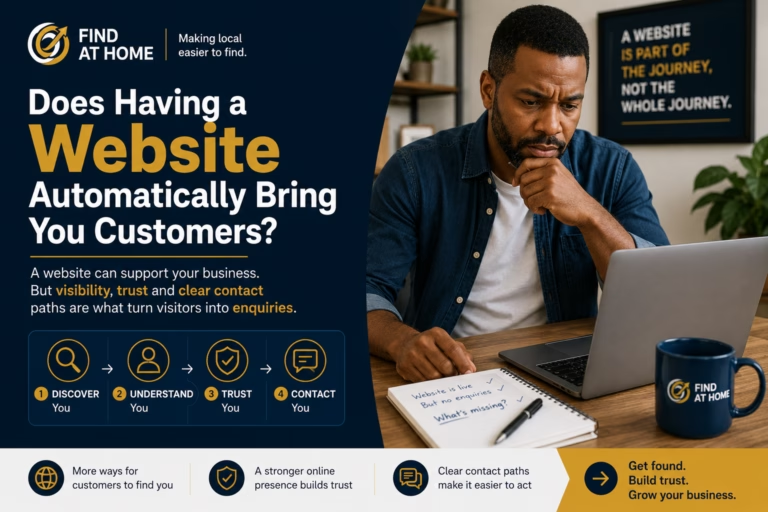
How easy is it for a potential customer to discover my business, understand what I offer, trust what they see and contact me?
First, what are we actually comparing?
Let us keep this simple.
Google Business Profile
A Google Business Profile can help your business appear across Google services, particularly when people search for your business, a relevant service or businesses in a particular area.
Depending on the business and profile setup, customers may see information such as:
- Business name
- Business category
- Location or service area
- Opening hours
- Phone number
- Website
- Photographs
- Reviews
- Directions
For many local businesses, this can be an important discovery and verification point.
Your business website
Your website is your dedicated online space for presenting your business in more depth.
It can explain:
- Who you are
- What you do
- Which services you provide
- Who you serve
- Where you operate
- Examples of your work
- Frequently asked questions
- How customers can contact you
A website gives you much more room to organise and explain your business than a short profile can.
A local directory or discovery platform
A local directory or discovery platform gives customers another place to search for relevant providers.
Instead of already knowing your business name, a customer may begin with a need:
- I need a plumber.
- I am looking for a school.
- I need an accountant.
- I need a construction company.
- I am looking for a local NGO.
- I need a professional near me.
The platform can then help connect that search with relevant organisations or providers.
That is the role Find At Home is designed to support.
So which one is the most important?
There is no universal answer.
Different businesses get customers in different ways.
A plumber may depend heavily on local Google searches.
A consultant may receive most enquiries through referrals and LinkedIn.
A school may need parents to find detailed information about programmes, location and contact details.
An NGO may need people to understand its mission and activities before making contact.
A construction company may rely heavily on referrals but still need somewhere professional to show its services and previous work.
The right online presence depends on how your customers actually look for, evaluate and contact a business like yours.
What is Google Business Profile particularly useful for?
Local discovery
Imagine someone searches for:
“plumber near me”
or:
“accountant in Krugersdorp”
Google may show relevant local businesses and map results.
A well-maintained Business Profile can help a potential customer discover that your business exists.
Quick practical information
Customers often want basic information immediately:
- Are you open?
- Where are you?
- Can I call you?
- Can I visit your website?
- What do other customers say?
A Google Business Profile can make this information easier to access.
Reviews
Reviews can provide useful signals when a potential customer is comparing businesses.
They do not tell the whole story, but genuine reviews can help customers understand other people’s experiences.
Think of Google Business Profile as an important local discovery and verification point.
What can your website do differently?
Google may introduce someone to your business.
Your website can continue the conversation.
Explain complicated services
Some businesses cannot properly explain what they do in a few lines.
Imagine a construction company offering:
- Building
- Renovations
- Project management
- Maintenance
- Commercial projects
- Residential projects
A website can give each important service enough space to be understood.
Show your work
Customers may want to see:
- Completed projects
- Before-and-after photographs
- Facilities
- Team members
- Products or services
- Case studies
A website gives you more control over how this information is organised and presented.
Answer questions before customers contact you
If customers repeatedly ask the same questions, your website can answer many of them before the conversation begins.
This can save time for both sides.
Create clearer enquiry paths
Once someone understands the business, the website can guide them towards an appropriate next step:
- WhatsApp us
- Call us
- Request a quote
- Send an enquiry
- Visit us
Think of your website as the place where customers can understand your business in greater depth.
Then what does a local directory add?
This is where many business owners understandably ask:
“If I already have Google and a website, why would I need another listing?”
The answer is not that a directory should replace either one.
It can create an additional discovery path.
Customers may search by need rather than business name
Someone may not know that your business exists.
They simply know what they need.
A local discovery platform can organise businesses by things such as:
- Category
- Service type
- Area
- Organisation type
That creates another route between the customer’s need and your business.
Customers can compare relevant options
A directory can help customers explore several relevant providers rather than searching for one particular business name.
This can be especially useful during the discovery stage.
It gives your business another online presence
Your website is one online destination.
Your Google Business Profile is another.
A relevant directory listing can become another.
That does not mean more listings automatically equal more customers.
Quality, relevance and accuracy matter.
The objective is not to put your business everywhere. It is to be present in sensible places where potential customers may actually look.
Where does Find At Home fit?
Find At Home is designed as a South African local discovery platform for:
- Businesses
- Professionals
- Schools and education providers
- Institutions
- NGOs and NPOs
- Churches
- Community organisations
The purpose is straightforward:
Help people discover relevant local organisations and make it easier to contact them.
A Find At Home profile can present useful information such as the organisation’s category, area, description, services, images and contact options, depending on the applicable listing.
Customers can then move directly towards actions such as WhatsApp, phone, email or the organisation’s website where available.
Does a Find At Home Listing replace your website?
No.
For some very small organisations, a listing may provide enough online information for their immediate needs.
But a Find At Home Listing and a full business website are designed for different levels of information and control.
A listing is useful for discovery and presenting important business information in a structured format.
A website can go much deeper into your services, story, work, resources, content and customer journey.
They can work together.
Does your website replace Google Business Profile?
Usually, that would not be a sensible way to think about it either.
If Google Business Profile is relevant to your organisation, having an accurate profile can give customers another useful way to discover and verify you.
Your website can then provide the deeper information that the customer may want next.
Do you need all three?
Not necessarily.
This is important because businesses should not spend money on tools simply because somebody tells them they “must”.
Start with the customer journey.
Ask:
- How do customers normally discover businesses like mine?
- What information do they need before trusting us?
- Where can they see our services and work?
- How easily can they contact us?
- Which parts of that journey are currently weak?
Then build around the gaps.
You do not need every digital tool. You need the right combination of tools for your business and your customers.
A simple example
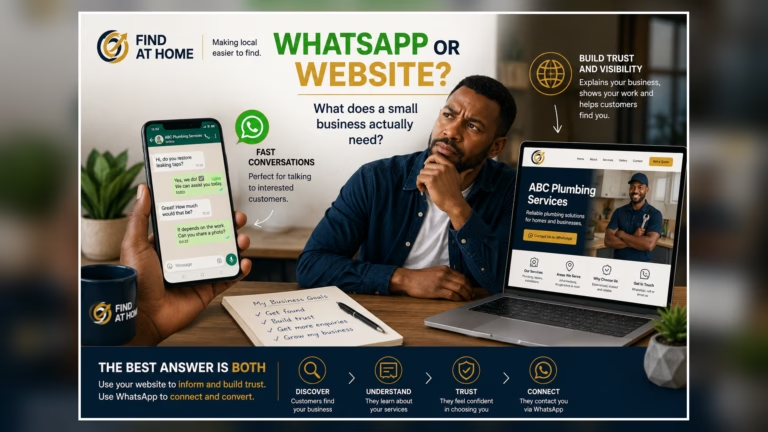
Imagine a homeowner has a leaking pipe.
Step 1: Discovery
They search Google or a local platform for a plumber.
Step 2: First impression
They see several businesses and begin comparing them.
Step 3: Verification
They check business information, reviews, photographs or a listing.
Step 4: Understanding
They visit a website and confirm that the plumber provides the service they need and works in their area.
Step 5: Contact
They tap the WhatsApp button and send:
“Hi, do you repair leaking pipes in my area?”
Notice what happened.
No single tool necessarily did everything.
Several tools supported different stages of one customer journey.
Another example: a school
A parent may search for schools in a particular area.
They may discover the school through Google, Find At Home, social media or a recommendation.
Then they may want much more information:
- Which grades are offered?
- Where is the school?
- What is the educational approach?
- What facilities are available?
- How does admission work?
- Who can I contact?
A directory listing can help with discovery.
A website can provide more detailed information.
Phone, email or WhatsApp can then support the actual enquiry.
Another example: an NGO or community organisation
The goal may not even be a traditional sale.
A person may be trying to:
- Understand the organisation’s work
- Find support
- Volunteer
- Make contact
- Attend an activity
- Explore a partnership
Again, different online tools can support different parts of that journey.
Google Business Profile vs Website vs Local Directory
| What the customer needs | Google Business Profile | Website | Local Directory / Find At Home |
|---|---|---|---|
| Discover local options | Strong role | Can support search visibility | Strong role |
| See quick business information | Strong role | Yes | Strong role |
| Read detailed service information | Limited space | Strong role | Depends on listing |
| See reviews | Strong role | Can display selected testimonials | Depends on platform features |
| Show detailed portfolio or content | Limited | Strong role | Limited by listing format |
| Control presentation and structure | Limited to Google’s format | Strongest control | Limited to platform format |
| Direct contact | Yes | Yes | Yes, where provided |
| Own dedicated online destination | No | Yes | No |
One important difference: control
There is another reason a website plays a different role.
Your profiles on Google, social media and directories operate within somebody else’s platform.
The platform determines the layout, features and rules.
Your own website gives you much greater control over:
- Your presentation
- Your page structure
- Your service information
- Your content
- Your customer journey
- Your calls to action
This does not make external platforms bad.
It simply means they should not be confused with an online property built specifically around your business.
Do not create profiles you cannot maintain
There is also a danger in trying to be everywhere.
Imagine a customer finds:
- One phone number on Google
- Another number on Facebook
- An old address on a directory
- Different opening hours on your website
Instead of building trust, your online presence creates confusion.
Three accurate online presences are better than ten abandoned ones.
Keep important business information consistent wherever customers may find you.
What should a small business prioritise?
If your budget and time are limited, think in this order:
1. Can people find you?
Make sure you have sensible discovery channels relevant to your type of business.
2. Can they understand you?
Make your services, location and business information clear.
3. Can they trust what they see?
Use accurate information, professional presentation, real photographs where possible and genuine evidence of your work.
4. Can they contact you easily?
Do not hide the next step.
Phone, WhatsApp, email or enquiry options should be easy to find.
5. Can you maintain what you have built?
An online presence should remain accurate after launch.
The better way to think about your online presence
Instead of asking:
“Google, website or directory — which one wins?”
Ask:
“Where might my customer look for me, what will they need to know when they find me, and how will they contact me?”
Then the roles become much easier to understand.
Google Business Profile can help with local discovery and verification.
Your website can explain your business in depth and give you greater control over your online presentation.
A relevant local directory can create another discovery route for customers looking by service, category or area.
WhatsApp, phone and enquiry tools can turn that interest into a conversation.
The bottom line
You do not have to choose one digital tool and expect it to solve every problem.
A stronger online presence often comes from giving customers a clear journey:
Discover → Understand → Verify → Contact
For one customer, that journey might be:
Google → Website → WhatsApp
For another:
Find At Home → Business Profile → Phone Call
For another:
Referral → Google → Website → Enquiry
The exact route matters less than the outcome:
Make it easy for the right people to find you, understand you and take the next step.