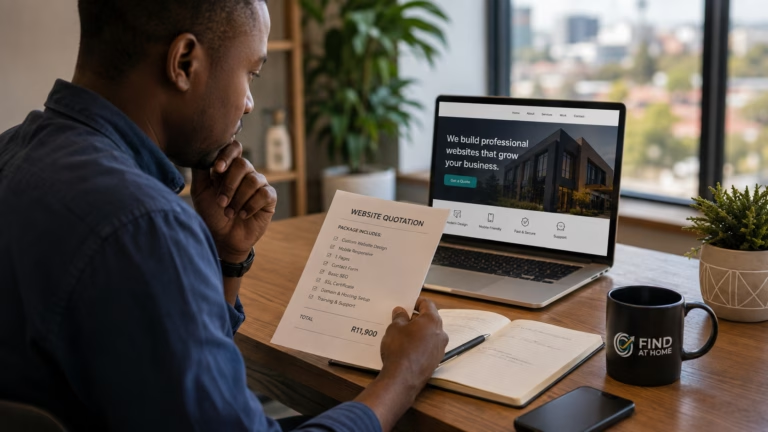


You paid for a website. It looks professional. It is live.
So where are the customers?
This is one of the most important expectations to get right before investing in a business website.
A website can support customer growth. But a website by itself does not automatically create demand, visibility or sales.
A website is part of the customer journey — not the whole journey.
Customers still need to discover you, understand what you offer, trust what they see and take action.
- Discover you — the customer first needs a way to find your business.
- Understand you — they need to quickly understand what you offer and whether it is relevant to them.
- Trust you — your online presence needs to give them enough confidence to continue.
- Contact you — when they are ready, the next step should be simple.
Many business owners naturally hope that launching a website will immediately bring enquiries.
Sometimes a website does start helping quickly — especially if the business already has referrals, repeat customers, Google visibility, social media activity or people actively searching for the brand.
But if nobody knows the website exists, even a very good website can sit quietly online.
What a good business website actually does
A business website has an important job. But that job is much broader than simply “bringing customers”.
Explains what you do
Customers can understand your services, who you help and what makes your business relevant to them.
Builds confidence
A professional website can make your business feel more established and easier to evaluate.
Gives customers somewhere to verify you
People who hear about you through referrals, social media, Google or somewhere else can visit one place to learn more before deciding whether to contact you.
Makes contact easier
Phone, WhatsApp, enquiry forms and clear calls to action can reduce friction when a customer is ready to take the next step.
Supports search visibility
Useful service pages and a technically sound website can give search engines more information about your business and what you offer.
Supports your other marketing
Your social media, business cards, quotations, adverts, Google Business Profile and directory listings can all send interested people back to your website.
Business owner takeaway: A website gives people somewhere professional to go once they know about you. It does not replace the work of helping people discover you.
Why a new website may not bring enquiries immediately
There are several common reasons why a perfectly good website can still feel very quiet after launch.
1. Customers do not know the website exists
If the website is new and you do not promote it, there may be very little traffic at first.
A website cannot persuade visitors who never arrive.
2. Your business is difficult to discover
Your Google Business Profile may be incomplete. Your business may not appear on relevant local discovery platforms. Your social pages may not link back to the website. Your service pages may also be too vague for customers and search engines to clearly understand what you offer.
All of these can reduce the number of paths that lead potential customers to your business.
3. The website does not answer the customer’s real questions
A beautiful homepage is useful, but customers normally want practical answers:
- Do you provide the service I need?
- Where do you operate?
- Can I see examples of your work?
- Can I trust this business?
- How do I contact you?
If those answers are difficult to find, visitors may leave without enquiring.
4. The contact path is too difficult
A customer may be interested but not ready to complete a long enquiry form.
For many local businesses, clear options such as Call, WhatsApp or Request a Quote can make the next step much easier.
5. The offer itself may need work
Marketing cannot fix every business problem.
If the price, service, location, response time, reputation or offer does not match what customers need, the website alone cannot solve that.
Business owner takeaway: If your website is not generating enquiries, do not immediately assume that “websites do not work”. First ask where the customer journey is breaking.
Where do customers usually come from?
For a local business, discovery can happen through several different channels.
1. Google Business Profile and Google Maps
These can help when customers search for a particular type of business or service in their area.
2. Search engines
Your website may appear for relevant searches over time when its content, structure and technical setup support search visibility.
3. Referrals and word of mouth
Someone recommends your business, and the potential customer visits your website to learn more before contacting you.
4. Social media
Facebook, Instagram, LinkedIn or TikTok can create awareness and send interested people to your website.
5. Local discovery platforms
Directories and local discovery platforms can create another route for customers to find and compare businesses.
6. Advertising
Paid advertising can send targeted visitors to your website or a dedicated landing page when it makes sense for your business.
A strong online presence often works because these channels support one another.
Google may help someone discover you.
Your website may help them trust you.
WhatsApp may help them start the conversation.
What does Find At Home add to the picture?
Find At Home is designed to create another local discovery path for businesses, professionals and institutions.
A customer can search by service, category or area, discover a relevant listing, learn more about the organisation and then contact it directly.
For a business that already has a website, the two can work together:
- Find At Home creates another discovery point.
- Your website gives interested customers more detail and context.
- WhatsApp, phone and enquiry options give them a clear next step.
This does not mean a Find At Home Listing or a website can guarantee customers.
Demand, competition, location, pricing, responsiveness, reputation and ongoing promotion all still matter.
The principle is simple: Give customers more sensible ways to discover you, understand you and contact you.
So what should you expect from a website?
A reasonable expectation is:
- A professional place to explain your business
- A better way to present your services
- A website that works properly on mobile
- Clear contact and enquiry paths
- A foundation for search visibility and future marketing
- A destination for Google, social media, referrals, listings and advertising
An unreasonable expectation is:
“I paid for a website, therefore the website provider should now guarantee me customers.”
No responsible website provider can control customer demand, Google rankings, competitors, customer behaviour or your final sales process.
What a provider can do is help build a strong, practical online foundation within the agreed scope.
How can you give your website a better chance of helping?
- Make your services clear. Avoid vague wording that forces customers to guess what you actually do.
- Keep your contact details consistent. Your website, Google Business Profile and other business listings should point customers to the correct information.
- Make WhatsApp, phone and enquiry options easy to find. Do not make interested customers hunt for a way to contact you.
- Use real, useful business images where possible. Show customers the business, people, work, facilities or services they are considering.
- Keep your Google Business Profile accurate. Opening hours, contact information, location and website details should stay current.
- Share your website. Put it on quotations, social profiles, business cards, email signatures and relevant listings.
- Build visibility over time. Useful content, local SEO, genuine reviews, referrals and appropriate promotion can all contribute.
- Respond to enquiries. Visibility is wasted if interested customers struggle to get a reply.
Website vs marketing: you normally need both roles
This does not mean every small business needs an expensive marketing campaign.
It means that your website and your visibility channels perform different jobs.
Your website
Your website explains, reassures, presents your services and helps turn existing interest into contact.
Your visibility channels
Your visibility channels help potential customers discover that your business — and your website — exist.
For some businesses, referrals and a strong Google Business Profile may already provide significant discovery.
For others, social media, local directories, SEO, networking or advertising may also be necessary.
There is no single combination that guarantees success.
Before you blame the website
If your website is live but enquiries are low, ask these questions:
- Are people actually visiting the website?
- Can they immediately understand what we do?
- Is the website easy to use on a phone?
- Can customers find our contact options quickly?
- Are we visible on Google and other relevant channels?
- Do we give people enough reason to trust us?
- Are we responding quickly when people enquire?
- Is our service offer competitive and relevant?
Those answers can tell you much more than simply saying:
“My website isn’t bringing customers.”
The bottom line
A website is not a magic customer machine.
It is a business asset.
It can help customers understand you, trust you and contact you. It can support Google, social media, referrals, local discovery platforms and advertising.
But customers still need a way to discover you in the first place.
Think about the whole journey:
Discovery → Understanding → Confidence → Contact → Customer experience.
The strongest online presence is not simply a website sitting on the internet. It is a connected system that gives potential customers clear ways to find you, understand you, trust you and contact you.