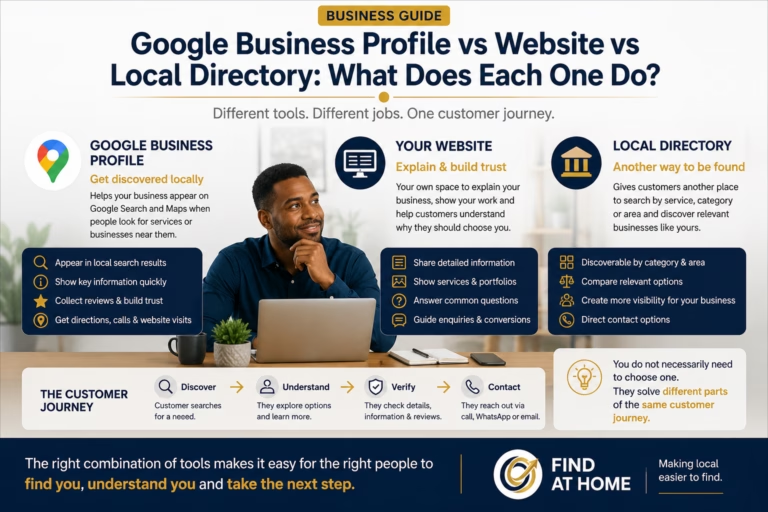


Local SEO helps people discover a business when they search for a nearby product, service or organisation. It is not a trick that pushes a company to number one overnight. It is the work of making the business clear, useful, trustworthy and technically accessible across the places where customers search.
For many South African small businesses, the strongest starting point is not a complex marketing campaign. It is accurate business information, a focused website, a well-maintained Google Business Profile and a reliable way to answer enquiries.
Step 1: Choose the customers and locations you genuinely serve
Trying to rank for every service in every city usually produces weak pages. Begin with the real business model.
Write down:
- the three to five services that matter most;
- the towns, suburbs or provinces genuinely served;
- whether customers visit you or you travel to them;
- the type of customer you help; and
- the action you want a visitor to take.
A Durban restaurant, a Johannesburg mobile plumber and a national online consultant need different local strategies. Do not create location claims that the business cannot support.
Step 2: Build one clear page for each important service or need
A homepage cannot explain every service in enough detail. Create focused service pages when there is enough unique information to help the customer.
A useful service page should answer:
- what the service includes;
- who it is for;
- common problems it solves;
- the area served;
- what the process looks like;
- relevant qualifications or evidence;
- frequently asked questions; and
- how to request a quote or booking.
Do not copy the same page and replace only the suburb name. Google warns against scaled pages created mainly to manipulate rankings. A location page should contain information that is genuinely useful for that location or it may not deserve to exist.
Step 3: Use the words customers use
Business owners often describe services differently from customers. A company may say “integrated water-management solutions” while the customer searches “leaking pipe repair near me”.
Collect language from:
- real phone and WhatsApp enquiries;
- quote requests;
- customer questions;
- Google Business Profile data;
- website search data; and
- conversations with frontline staff.
Use the main phrase naturally in the page title, heading, introductory paragraph and descriptive link text where it helps. Avoid repeating keywords until the copy becomes unnatural.
Google’s Search Essentials recommends using words people use to find the content and placing them in prominent, descriptive locations.
Step 4: Optimise your Google Business Profile
For eligible storefront and service-area businesses, a Google Business Profile can appear in Maps and local search results.
Keep the name, primary category, contact details, hours, location or service area, services and photos accurate. Ask genuine customers for honest reviews and respond constructively.
Google explains that local results are mainly based on relevance, distance and prominence. You can improve clarity and trust, but you cannot buy or guarantee an organic position.
Follow our full guide to improving a Google Business Profile in South Africa.
Step 5: Keep business information consistent across trusted profiles
Customers may encounter the business on Google, Find At Home, social platforms, professional directories and the company website. Names, telephone numbers, locations and service descriptions should not contradict one another.
Consistency does not mean every profile must contain identical text. Tailor the presentation while keeping the underlying facts accurate.
Prioritise directories and associations that are relevant, maintained and useful to customers. Hundreds of low-quality automated directory submissions are not a substitute for a few trustworthy profiles.
Step 6: Make the website easy to crawl and navigate
Search engines discover pages partly through links. Important pages should be reachable through the site’s navigation or contextual internal links, not hidden behind a search box.
Use descriptive links such as “emergency plumbing services” rather than repeated “click here” text. Google’s link best practices explain that relevant anchor text helps people and Google understand the destination.
Also check:
- each page has one clear main heading;
- page titles and meta descriptions are unique;
- URLs are short and descriptive;
- images have useful alt text;
- mobile users can call or enquire easily;
- broken links are repaired; and
- the website uses HTTPS.
Step 7: Publish content that solves pre-purchase questions
Helpful articles can bring the right customer before they are ready to choose a provider. A contractor could explain how to compare renovation quotes. A school could explain what parents should bring to an open day. A clinic could explain its booking process without giving unsafe medical advice.
Good local content should:
- answer one real question;
- add experience or local context;
- use reliable sources for factual claims;
- show who created or reviewed it;
- link to the relevant service page; and
- avoid pretending that word count equals quality.
Google’s people-first content guidance asks whether visitors leave feeling they learned enough to achieve their goal. Use that as the standard.
Step 8: Earn trust, references and genuine reviews
Links and mentions from relevant local organisations, suppliers, professional bodies, community partners and news sources can help customers discover the business and support its reputation.
Earn them through real activity: partnerships, useful resources, sponsorships with genuine community value, expert commentary and work worth referencing. Avoid buying large packages of anonymous links.
Create a consistent review-request process after real transactions. Read our guide on earning customer reviews ethically.
Step 9: Connect search visibility to a working enquiry process
Ranking is not the business goal. A useful enquiry is.
Test the customer journey on a phone:
- Does the page load quickly?
- Is the service easy to understand?
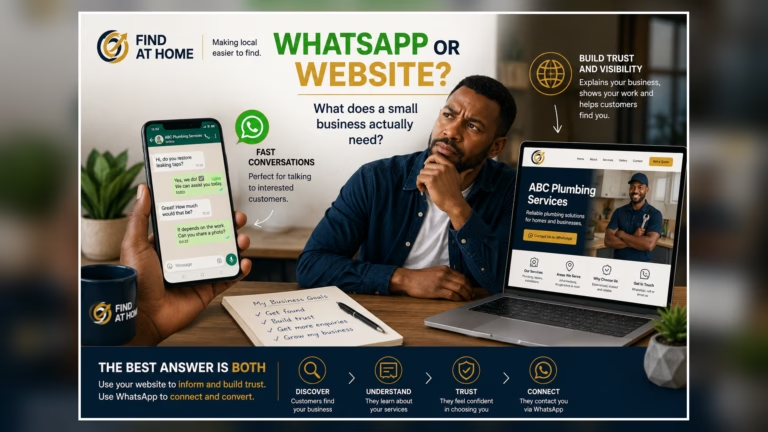
- Can the person call or WhatsApp?
- Is the contact form short?
- Does someone respond?
- Is the business name clear in the reply?
Our WhatsApp Business guide shows how to turn messages into an organised follow-up process.
Step 10: Measure leads, not vanity metrics
Set up Google Search Console and suitable analytics. Track impressions and clicks, but also track enquiries, calls, quote requests, bookings and the pages that support them.
Review monthly:
- which searches bring relevant visitors;
- which pages receive impressions but few clicks;
- which pages lead to enquiries;
- which services have weak or outdated content;
- technical indexing problems; and
- customer questions that deserve new content.
Do not make major changes every few days. SEO needs enough time and data to show meaningful patterns.
A practical 90-day local SEO plan
Month 1: Fix the foundation
- Confirm business name, services, areas and contact details.
- Complete the Google Business Profile.
- Repair the website’s key pages and mobile contact journey.
- Create or improve the Find At Home listing.
- Connect Search Console and submit the sitemap.
Month 2: Build useful service content
- Improve the top three service pages.
- Add genuine project photographs and evidence.
- Create one or two useful customer guides.
- Add internal links between related pages.
Month 3: Strengthen trust and measure
- Start a compliant review-request routine.
- Seek relevant local mentions and partnerships.
- Review Search Console queries and enquiry quality.
- Improve pages based on real customer questions.
Frequently asked questions
How long does local SEO take?
There is no fixed timeline. Technical fixes can be visible quickly, while competitive search growth may take months. Location, competition, website history, relevance and prominence all matter.
Can I rank in cities where I do not operate?
Creating pages for places you do not genuinely serve can mislead users and produce thin content. Focus on real service areas and provide useful location-specific information.
Do I need a blog for local SEO?
Not every business needs frequent posts. Strong service pages, accurate profiles and a helpful website come first. Publish articles when you have real customer questions worth answering.
Can Find At Home guarantee Google rankings?
No responsible provider can guarantee a particular organic ranking. Find At Home can help businesses strengthen their information, website, listing and local visibility foundation.
Give customers more than one way to find you
Local SEO is strongest when the facts agree and the customer journey works across search, your website and trusted local platforms.
Get your business listed on Find At Home and build a clearer local presence.
Search products, ranking systems and platform features change. Use current official documentation and judge progress by relevant enquiries, not promises of instant rankings.