
“My customers already WhatsApp me. Why do I need a website?”
For many small businesses in South Africa, that is a completely reasonable question.
WhatsApp is fast, familiar and convenient. A customer can ask a question, request a quote, send a location or start a conversation within seconds.
So if WhatsApp already works, why spend money on a website?
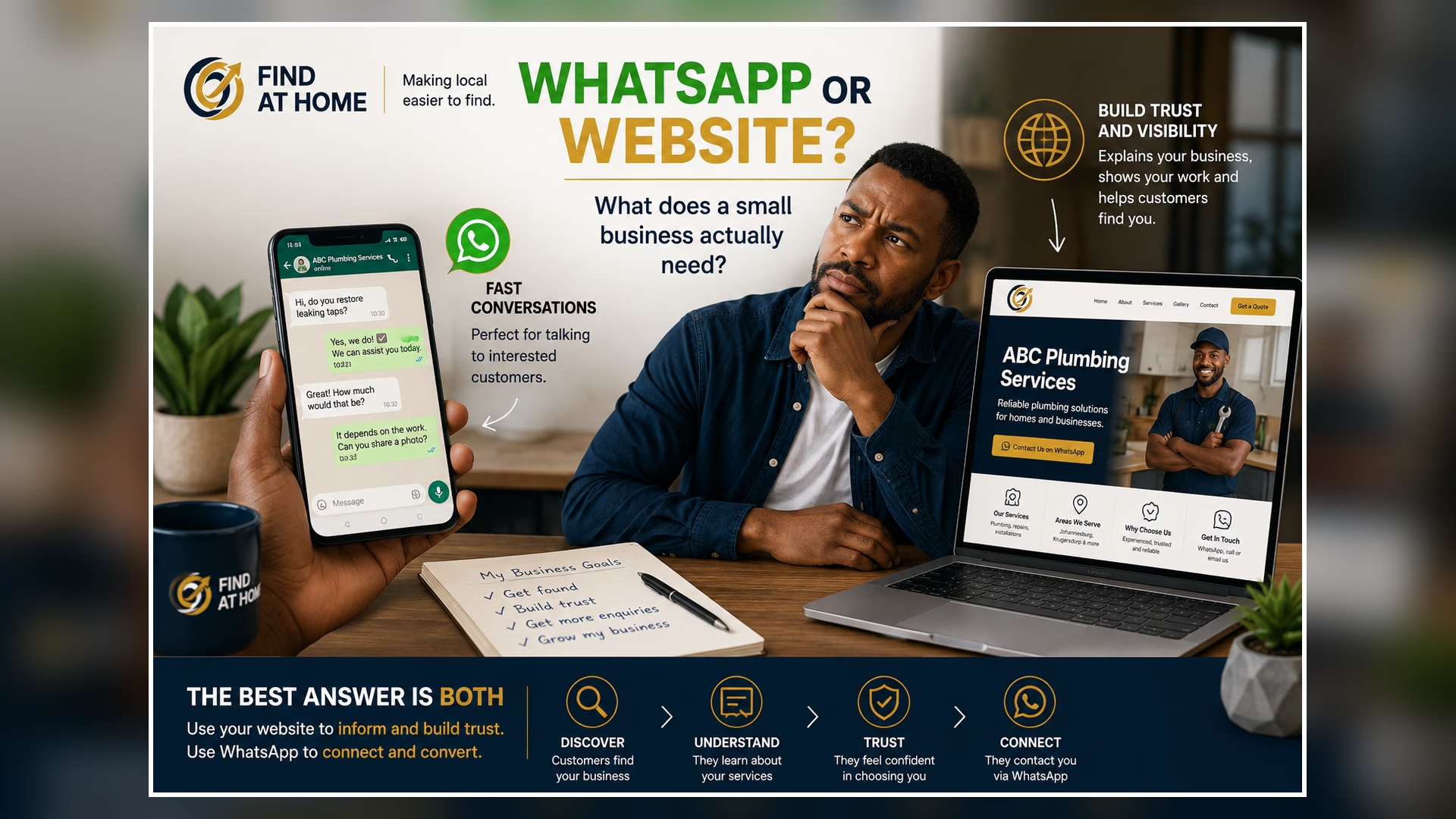
Because WhatsApp and a website solve different problems.
WhatsApp is excellent for talking to a customer who is already interested.
A website helps that customer understand your business, evaluate you and build confidence — sometimes before they are ready to message you at all.
For many businesses, the best answer is therefore not WhatsApp or Website.
It is:
Website + WhatsApp, each doing the job it does best.
What is WhatsApp really good at?
WhatsApp is one of the most useful communication tools available to a small business.
It is especially good when a potential customer already knows enough about your business to start a conversation.
Quick enquiries
A customer can ask:
- Are you available today?
- Do you work in my area?
- How much does this service cost?
- Can you send me a quotation?
- Can I make an appointment?
There is very little friction.
Direct conversations
Instead of sending an email and waiting, customers can communicate directly with the business.
For many local service businesses, that is extremely valuable.
Photos, documents and locations
Customers can send photographs, documents, voice notes or locations without needing a complicated online system.
A builder can receive photographs of a damaged wall.
An appliance repair company can ask for a picture of the machine.
A customer can share their location before a site visit.
Following up
Once a conversation has started, WhatsApp can make follow-up easier for both sides.
WhatsApp is excellent at conversation.
So what is WhatsApp not designed to do?
This is where the difference becomes important.
A WhatsApp number does not automatically explain your entire business.
Before messaging you, a new customer may still want to know:
- Who are you?
- What exactly do you do?
- Which areas do you serve?
- What does your work look like?
- What services do you offer?
- Are you an established business?
- Can I trust you?
If all of that information has to be explained manually in WhatsApp every time someone enquires, you may find yourself repeating the same conversation again and again.
WhatsApp is a conversation tool. It is not a complete business presentation.
What does a website do that WhatsApp does not?
1. It explains your business before the conversation starts
A good website can answer many basic questions before the customer contacts you.
For example:
- What services you provide
- Who you serve
- Where you operate
- How the business works
- Examples of your work
- Frequently asked questions
- How to contact you
That means the customer who eventually reaches WhatsApp may already understand much more about the business.
2. It gives customers somewhere to check you
Imagine somebody recommends your business.
The potential customer may not immediately send you a message.
They may first search your business name online.
If they find a professional website containing consistent business information, services, photographs and contact details, that can help them evaluate whether they want to continue.
The website becomes part of the trust-building process.
3. It can explain more than a WhatsApp profile
A WhatsApp Business profile can contain useful information, but space and structure are limited.
A website can organise information into dedicated sections or pages.
For example, a construction company may want separate information about:
- Building services
- Renovations
- Projects
- Previous work
- Areas served
- Company background
- Contact details
Trying to explain all of that inside a WhatsApp conversation can become cumbersome.
4. A website can support search visibility
People do not only search for business names.
They may search for the service they need.
A properly structured website can give search engines information about your business, services and location.
That does not mean launching a website automatically gives you high Google rankings.
But without useful web content, search engines have less information to understand and potentially surface.
5. Your website is available when you are not
You may be:
- Working with another customer
- Driving
- On a job site
- In a meeting
- Sleeping
Your website can still explain your services while you are unavailable.
The customer can read first and message you afterwards.
Your website can answer basic questions before you personally enter the conversation.
Then why not just use a website and forget WhatsApp?
Because that would ignore how many customers actually prefer to communicate.
A beautiful website that makes it difficult to contact the business can still lose enquiries.
For many local businesses, customers want a very simple next step:
“I understand what you do. Now let me WhatsApp you.”
That is why a website and WhatsApp can work so well together.
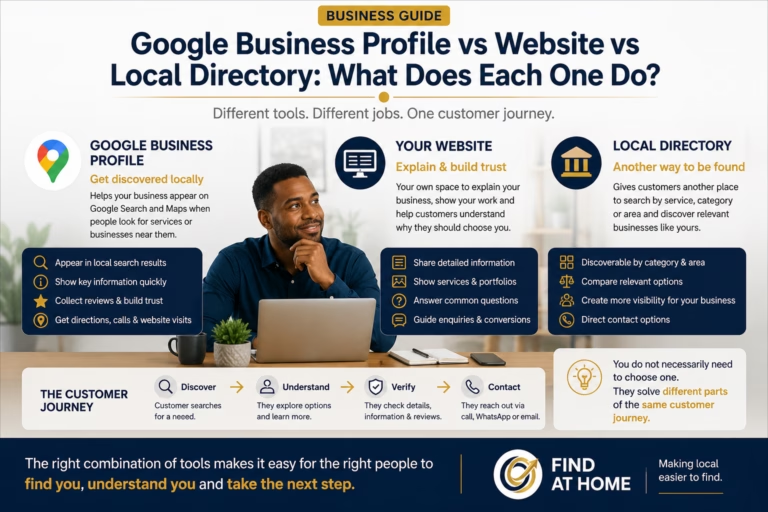
Think of it as a customer journey
A potential customer may move through several stages:
- Discover — they find your business through Google, Find At Home, social media, a referral or another source.
- Understand — they visit your website or business profile to understand what you offer.
- Trust — they look at your information, presentation, work and business details.
- Contact — they tap the WhatsApp button, call you or send an enquiry.
- Conversation — you answer questions, discuss the requirement and move towards a quotation or booking.
The website does not replace the conversation. It helps prepare the customer for it.
What if I am a very small business?
You may not need a large website.
A sole trader, consultant, home business or small service company may only need a focused online presence.
For example:
- Home
- About
- Services
- Contact
Or even fewer pages if the content can be organised clearly.
The purpose is not to build the biggest possible website.
The purpose is to give customers enough information to understand the business and confidently take the next step.
A smaller website that does its job properly can be more useful than a large website full of unnecessary pages.
What if most of my customers come from referrals?
That can actually make a website useful in a different way.
Suppose an existing customer tells a friend:
“Speak to this company. They did good work for me.”
The referral has already created interest.
But the new customer may still want to check the business before making contact.
They may search the business name, look at its website, check its services and then WhatsApp.
In that situation, the website did not create the referral.
It helped support the referral.
What if I already have a Google Business Profile?
Keep it.
A Google Business Profile can be extremely useful for local discovery.
It can show information such as:
- Your business name
- Location or service area
- Opening hours
- Reviews
- Photographs
- Telephone number
- Website link
But again, it performs a different role.
Google may help someone discover you.
Your website can help them understand you.
WhatsApp can help them talk to you.
These tools do not have to compete with one another.
Where does Find At Home fit?
Find At Home adds another local discovery route.
Customers can search for businesses, professionals and institutions by relevant categories and areas and then contact suitable providers.
A Find At Home Listing can therefore work alongside your other channels.
A simple customer journey might look like this:
Find At Home → Business Profile → Website → WhatsApp
Or:
Google → Website → WhatsApp
Or even:
Referral → Website → Phone Call
There is no rule saying every customer must follow the same path.
The objective is to give customers several sensible ways to find, understand and contact your business.
Do I need an online store to make my website useful?
No.
A website does not need to process payments to be valuable.
Many service businesses simply need the website to:
- Explain the service
- Show examples of work
- Build confidence
- Answer common questions
- Generate enquiries
- Send interested customers to WhatsApp or phone
That may be enough.
If your business genuinely needs online payments, bookings, delivery or e-commerce, those functions can be considered separately.
But there is no reason to make a simple business website unnecessarily complicated.
Can I start with WhatsApp and add a website later?
Yes.
Not every business needs to build everything at once.
If you are just starting and your budget is limited, you may begin with:
- A professional WhatsApp Business setup
- An accurate Google Business Profile
- A Find At Home Listing
- Consistent business information
- Good photographs and service descriptions
Then, when the business needs a stronger online presence, you can add a website.
Build what the business needs now — but leave yourself room to grow.
When does a website start making more sense?
You should seriously consider a website when:
- You repeatedly explain the same services to new customers
- Customers ask where they can see your work
- You want a more professional online presence
- You rely heavily on referrals and want somewhere to send those referrals
- You want customers to find detailed information without messaging first
- Your business offers several different services
- You want to build stronger search visibility over time
- You want one central place that connects your Google, social media, listings and contact channels
So which one should you choose?
If the question is:
“Should I have WhatsApp or a website?”
For many small businesses, that is the wrong comparison.
Instead ask:
“What does my customer need at each stage before they are ready to buy?”
| Customer need | Useful tool |
|---|---|
| Find a local business | Google, Find At Home, referrals, social media |
| Understand the business | Website and business profiles |
| Check credibility | Website, reviews, listings and business information |
| Ask a quick question | WhatsApp or phone |
| Request a quote | WhatsApp, phone or enquiry form |
| Continue the conversation | WhatsApp, phone or email |
Now the roles become much clearer.
The bottom line
WhatsApp is not the enemy of a website.
And a website should not make WhatsApp unnecessary.
They can work together.
Your website can explain your business while you are busy.
Your online visibility channels can help customers discover you.
And WhatsApp can make it easy for an interested customer to start a real conversation.
Discovery → Understanding → Trust → WhatsApp → Conversation.
For many small businesses, that is a much more practical way to think about an online presence.